What changed
This batch has focused on making the current local session more dependable before adding more places or encounters. Familiar scenery needs movement, ground contact and combat behavior that hold together when I actually play.
Patch notes: falling and creature movement
- Stopping horizontal movement during a fall no longer suspends gravity. Restarting movement cannot turn an airborne creature into a walking one.
- Idle presentation stops doing unnecessary work after landing. A fading creature stays physically stopped, and a rejected movement request cannot restart it.
- Creature step height and slope limits now match the player's movement rules. Capsule sizes remain unchanged.
- An incomplete path that ends on another floor no longer counts as a successful arrival. An unreachable target still follows the existing safe stall and release behavior.
These cases have passed controlled engine tests. They address specific failures; they do not establish that every forest path or encounter works.
Patch notes: following an obscured target
The navigation follower now responds when its target becomes obscured, including inside melee range. Its regression check uses an actual sight blocker, a detour and advancing game frames, then restores ordinary behavior when visibility returns.
This wiring is tested, but real regional navigation data still needs qualification. Ordinary encounters retain the existing fallback until that admission is complete. I have not enabled full Ronfaure navigation from a successful test alone.
Patch notes: local entry and maps
The San d'Oria nation-map grant now uses its own entry operation, and key items have readable names. Map access follows possession of the key item. The remaining map presentation and the full entry flow still need my playtest.
The latest packaged local session passed its selected entry, save, reopening, enemy-magic and market scenarios. Local audio assets loaded in that check; I still need to listen to the actual mix.
Ronfaure: matching collision to the original source
I found that the existing zone converter already understood separate retail collision geometry, but its normal zone export did not include it. I can now request that geometry explicitly and compare it with the surfaces used by Unreal.
I narrowed two initial foliage blockages to two faces in West Ronfaure's collision and tested a candidate that removed only those faces. The candidate cleared the initial contacts, preserved all 15,557 sampled floor points and both retained trunk contacts, and kept the visual mesh and materials unchanged. However, none of the five strict routes passed when replayed in both directions. Some reached further collision contacts, while others remained blocked at the start. I have kept the result as investigation evidence and am retaining the existing collision for the current game. The forest correction is still unfinished.
What it means for players
The goal is a more reliable local adventure: falling should remain natural, creatures should not mistake a different floor for their destination, and travel should not catch on a surface that does not match the scenery.
I am keeping the playable milestone centered on a complete session: choose a character, enter the world, travel, fight, receive rewards, save and return. Preparing an asset or passing a controlled scenario is one step toward that loop. It does not make a whole region ready.
What the screenshots show
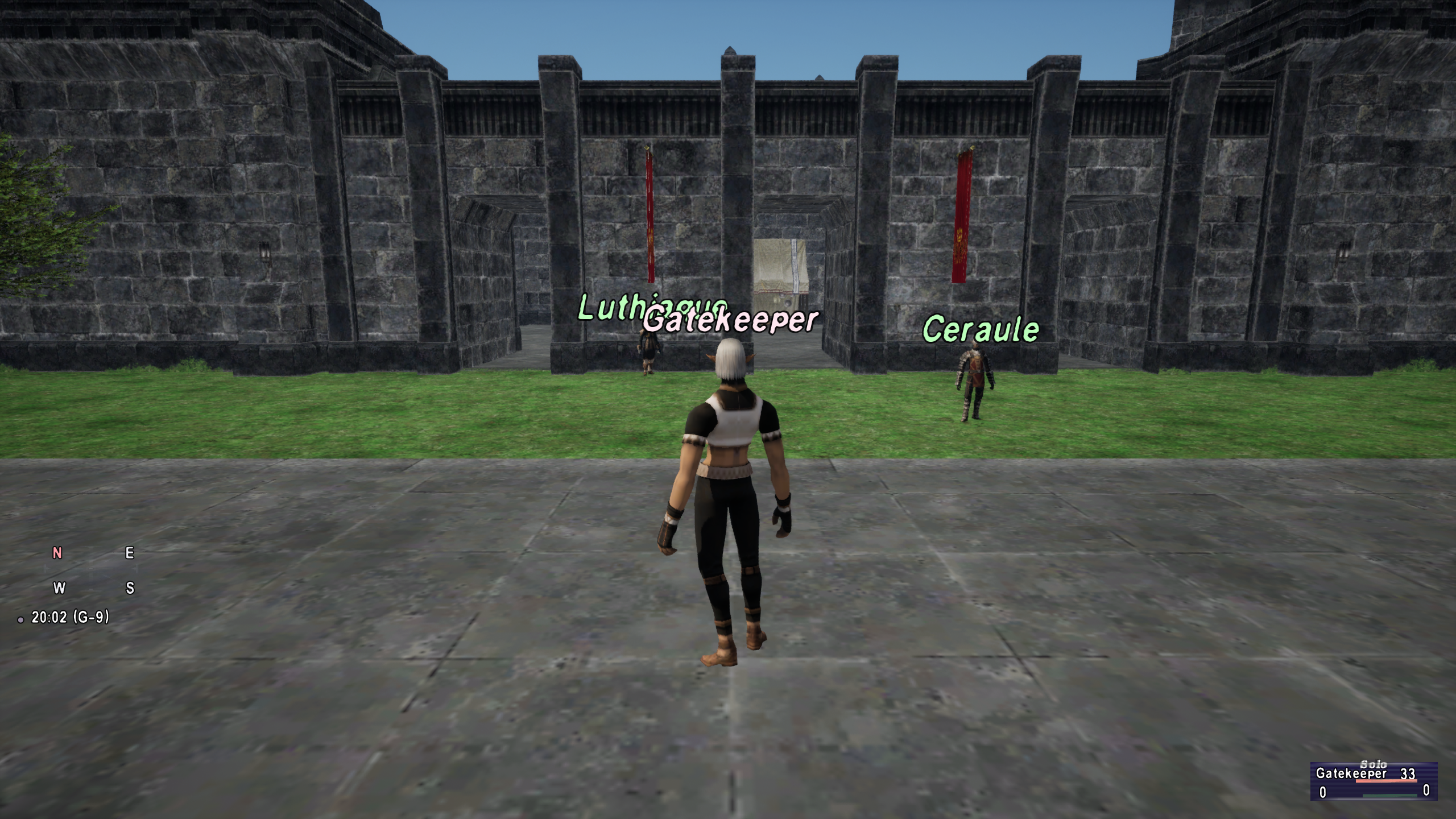
The screenshots are real, unedited captures from a packaged San d'Oria development session on 7 October. They show the current character, nearby NPCs and interface, including a first-person view in the gallery. The character is a test character. These are presentation captures, not demonstrations of a completed forest route or a hands-on playtest.
What still needs work
I still need to playtest ordinary movement, camera behavior, combat and the interface together. Automated and packaged checks give me repeatable evidence, but they do not tell me how the whole experience feels.
- Ronfaure still needs the remaining collision and both-direction travel checks. My latest candidate cleared two initial obstructions, but none of the five strict routes passed. Additional contacts still need investigation before I can call those routes ready.
- Real regional navigation, encounter ground contact and unsafe arrival cases remain qualification work.
- Moving performance remains open. A held scene did not reproduce the earlier rendering warning; that has not established its cause or fixed performance while travelling.
- Snow coverage needs a continuous transition into grass, with sensible roof and vertical-face behavior. I still need to judge that result while moving through the affected area.
- Audio cue timing, volume and the listening experience still need an actual playtest. Successful loading is a separate result.
The larger imported libraries have not expanded the admitted encounter roster or playable race coverage in this batch. There is no public download or testing signup.
What's next
I will investigate the additional contacts reached by the route replay, compare them with the original collision data, and test a bounded correction while preserving the ground and tree trunks. A route needs to pass in both directions before I move on to a fresh packaged check and my own playtest.
The direction remains original-era, pre-Zilart content with a dependable single-player foundation. Multiplayer follows that foundation. I will keep expanding through complete playable scenarios, while preserving Vana'diel's familiar places, silhouettes and atmosphere.