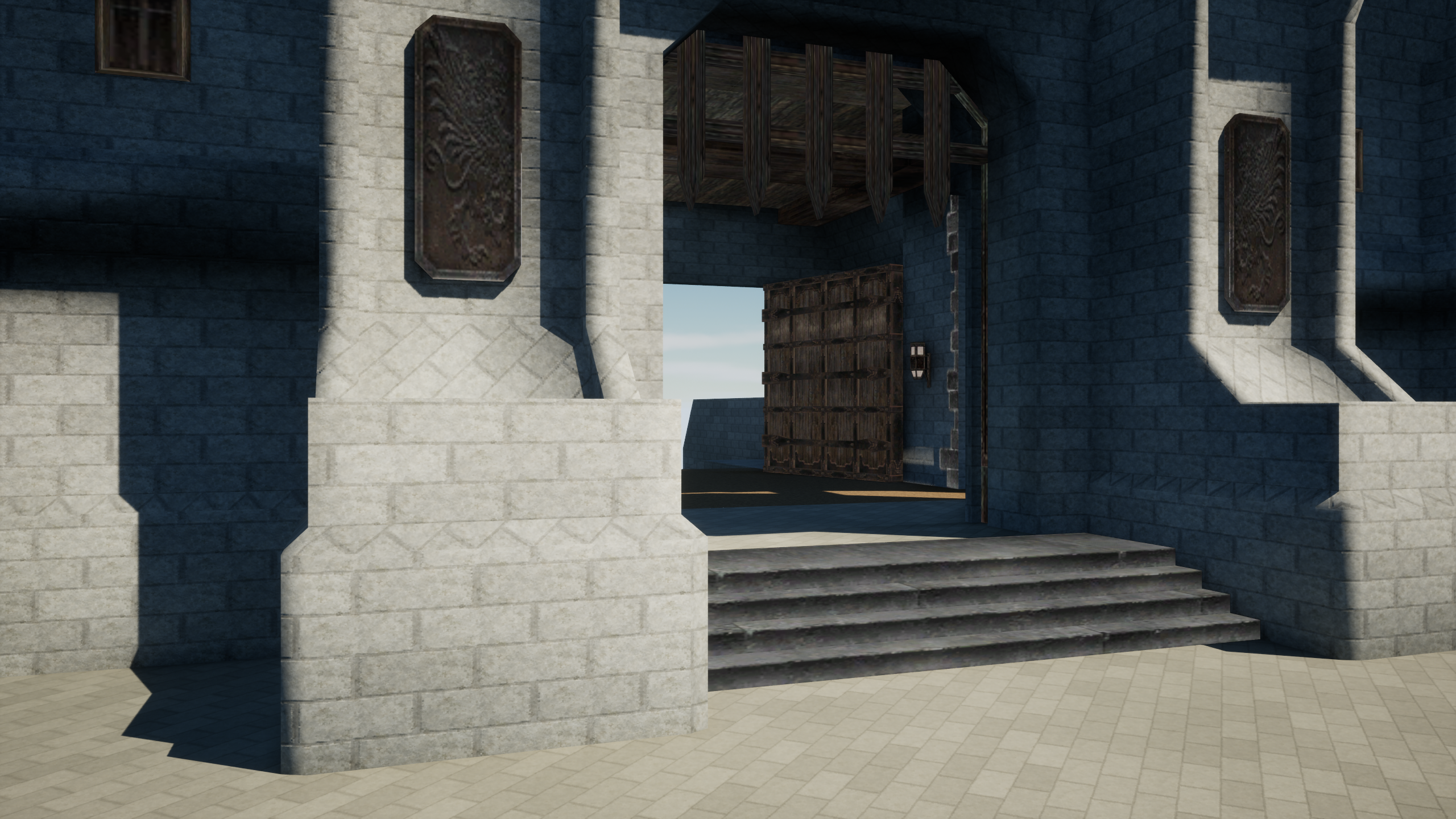
8 October follow-up: snow belongs on the exposed surfaces
I have repaired the pale snow patches on three recorded downward-facing surfaces beneath the gate in a fresh isolated sample. The change keeps the surface-facing calculation consistent as the camera moves. The original weather and shelter systems remain in use, and the earlier qualified samples are preserved.
The gallery now shows two unedited packaged captures titled “Snow beneath the gate: before” and “Snow beneath the gate: after”. From the city approach, the affected timber returns close to its daylight colour while exposed steps still collect snow. Twelve additional camera positions cover close, reverse and below views. Those close views were already clear in the earlier sample, so they are regression checks rather than twelve separate demonstrations of the fix. A covered upper ledge also stays clear; that does not establish every exposed top surface on the repaired materials.
The fresh Windows sample has passed all eight automated packaged gates: daylight, night, rain, snow and shelter, tree approach, isolated save/reload, trunk collision and the configured player character. The shared headless and rendered suites also passed. These checks qualify this revision for a hands-on retest; they do not establish controller feel, listening, moving performance or my final appearance approval. The remaining shadow warning is still recorded.
My direction remains aged, maintained fortress masonry and naturally worn ground that preserve San d’Oria’s identity. The previous wet-grass improvement is retained. Wood, roofs, metal, signs, foliage and water still need further material work. The full six-area retexture is still the plan, with production adoption at zero of the 298 inventoried visible material slots. I will carry the accepted standard through the region in reversible batches, while continuing the remaining collision and geometry repairs. Earlier findings and milestones remain below.
8 October follow-up: wet grass and the next weather repair
I found that rain made the grass in the gate sample look too much like a smooth sheet of water. I have adjusted only its wet surface roughness, keeping the dry appearance, wet darkening and the other materials unchanged. The new sample has passed its material import and reload checks, the wider headless and rendered test suites, and its packaged daylight, night, rain and snow checks. The tree route, isolated save/reload, trunk-collision and configured player-character checks have also passed, completing all eight automated packaged gates for this revision. The earlier package and my normal regional playtest build remain separate.
I also confirmed a separate snow problem: pale patches are appearing on downward-facing surfaces beneath the gate. Those patches come from snow coverage on retained original materials, rather than a missing texture. This grass repair leaves that issue unchanged. My next weather repair will check the underside coverage while preserving snow on exposed upward-facing surfaces.
This remains a small editable sample, not the completed regional upgrade. Production rollout is still zero of the 298 inventoried visible material slots across Southern, Northern and Port San d’Oria, the Chateau, East Ronfaure and West Ronfaure. The earlier article and tested milestone remain below. Hands-on play and my final look-and-feel acceptance are still separate from the automated results.
8 October: tested repairs and the first aged-material sample
I have moved from the playtest findings into tested repairs and a small editable environment sample. The original report below remains the record of what I found on 7 October; this update distinguishes what has since been implemented from the work still ahead.
Wear that belongs in San d’Oria
The first brick treatment was too clean. San d’Oria should feel like an old, maintained fortress in a world where conflict with the beastmen continues. I have revised the sample with weathered stone faces, worn mortar edges, shallow surface scars, darker staining near the base of walls and scuffed paving. Surface variation follows the masonry rather than repeating as obvious stripes. The original gate proportions, heraldry, stairs, timber and layout remain recognizable.
The Crystal War is historical context, while the Age of Adventurers still includes beastman raids. I am using that distinction to guide believable age and upkeep. These particular marks are an artistic interpretation, not a reconstruction of a documented battle at this gate. My references are the official [Crystal War history](https://www.playonline.com/ff11us/intro/about/history07.html?pageID=about) and [Age of Adventurers history](https://www.playonline.com/ff11us/intro/about/history08.html?pageID=about).
Repairs that have passed checks
The recorded trapped-position route now passes walking checks in both directions. Collision was removed only from three proven decorative plants, retaining their visible shapes and the surrounding trunks and ground. A small visible floor opening was restored from source geometry; existing floor collision already covered it. These named repairs do not mean every invisible wall or reported opening is fixed.
The new sample connects a roughly 60-metre gate route and a separate roughly 48-metre tree approach. It has original coordinated materials on retained source geometry, an original-texture comparison, and independently editable pieces. I changed a shared material instance, replaced an equivalent piece, rebuilt the sample and confirmed that the authored overrides and placements survived.
What the packaged milestone proves
The isolated Windows package passed eight automated checks covering daylight, night, rain, snow and shelter, the tree approach, disposable save/reload, trunk collision and the configured player character. The combined project also passed its headless and rendered suites. I separately captured the ordinary packaged startup with the real character at the unchanged starting point.
The gallery now includes an unedited daylight material comparison capture and an ordinary packaged player view. The first uses controlled inspection lighting; the player view uses the saved daylight rig. Neither is a finished whole-map screenshot. The sample retains cropped boundaries and original low-detail assets where replacements are still pending.
What is still unproven
Hands-on controls, moving performance, listening and my final look-and-feel acceptance remain separate. A virtual-shadow queue warning still appears. The daylight comparison no longer shows the pillar streaks at its tested light angle, but I have not qualified every angle of the normal day/night cycle. Controlled weather checks do not establish the ordinary scheduled weather experience. The isolated walking launcher uses a separate profile and does not replace my regular regional playtest build.
The next step is the whole current region
I will review this sample in play, refine the style where necessary, then carry the accepted standard through Southern, Northern and Port San d’Oria, the Chateau, East Ronfaure and West Ronfaure in reversible batches. Production rollout is still zero of the 298 inventoried visible material slots. The sample sets the standard; it does not reduce the approved scope. Wood, roofs, metal, signs, foliage, water and remaining broken geometry still need their own work and validation.
What changed
I have finished a longer hands-on playtest of the current San d’Oria and Ronfaure build. Walking through the region, fighting, using menus, changing the weather and returning to my character revealed problems that controlled checks had not resolved. This original 7 October report records those findings and the work I committed to next. The dated update above records the subsequently tested repairs; the rest remains a backlog unless explicitly qualified there.
Across two sessions, I kept 229 screenshots and 79 written observations. Some observations describe the same issue from different places, and a few record things that worked. They are a useful repair list, not a count of 79 unique bugs.
The world needs structural repair
I found gaps beside the Voidwatch Purveyor and much larger openings beneath the East San d’Oria wall. The screenshots show sky through those openings. Better texture images will not close missing surfaces, so I need to trace the geometry and repair the actual coverage.
I also saw flickering stonework, grass crossing stairs and abrupt grass-to-wall transitions near gates and city connections. Overlapping surfaces may explain some of the flicker, but I have not established that as the cause in every location. I will check the geometry, texture coordinates and material assignments together.
Collision is the first priority
Branches and apparently empty spaces sometimes blocked me, lifted the character or left me stuck. There were places where ground contact looked wrong, and I could reach unfinished-looking surfaces near city walls. After one branch incident, the game rejected my saved position because it started inside blocking collision. That gives me a concrete failure to reproduce.
An earlier forest correction cleared two initial contacts but still failed all five complete route checks. I did not adopt it. I will keep that failed result and use it to avoid repeating an incomplete fix. Trees still need solid trunks, walls still need to block movement, and foliage should not behave like invisible platforms.
Some connections held up
The passage between East and West Ronfaure functioned well during this session, although it needs visual cleanup. Travel between Northern San d’Oria and Port San d’Oria also felt smooth, with good arrival placement. I want to preserve that behavior while repairing the surrounding world.
What it means for players
I want the world to feel recognizable and comfortable to explore. That means a path should behave like a path, the ground should match what is visible, and a tree should not trap a character on an invisible branch surface. Controls and menus need to keep working throughout an ordinary session.
Better textures across the whole current map
I am planning a full retexture of the current San d’Oria and Ronfaure regional map. The first small sample will establish the quality and style; it is not the limit of the work.
The direction is familiar FFXI with modern, more realistic materials. I want to preserve the architecture, proportions, regional colors, terrain layout, landmarks and tree and water placements. Stone should have believable surface detail, timber and metal should respond naturally to light, and the forest floor and foliage should have more depth without losing Ronfaure’s atmosphere.
The material pass will cover stone and plaster, wood and roofs, metal and signs, roads and paths, soil and grass, rocks, bark, leaves and water surfaces. I will rebuild unsuitable pieces where better textures cannot correct the underlying asset. This is a region-wide commitment delivered in manageable sections, rather than one untested replacement of the entire map.
At the time of the original report, the masonry color study was preparation only. The 8 October update above records the imported and packaged sample that followed. The production map has not yet adopted it.
What the screenshots show
The new gallery captures are unedited images from my 7 October playtest. They show the current forest path, the wall seam near Voidwatch and the larger gaps at the city exterior. They document the starting condition and the problems I found. They are not before-and-after repair comparisons or images of the planned texture upgrade.
What still needs work
Controls, camera and movement
- I reported a loss of movement and zoom controls in the first session, followed by a more complete control lock around menu/debug-view interaction. A controller-change path can tear down the game’s input and interface, but the exact trigger in my session still needs reproduction.
- Mouse-wheel and numpad zoom need consistent, smooth behavior. First-person view should center correctly with the character, and moving around a target should not produce an unwanted camera fixation.
- Stairs felt abrupt and harsh. I need to separate ground movement from camera response and fix the source of that feeling.
- Movement should remain available in the magic and ability menus where intended.
Combat, targeting and character presentation
- Magic-list navigation needs held-key repeat, correct cursor alignment and useful page movement. Choosing a self-targeted spell should offer the expected target confirmation.
- Nearest-target selection, field-of-view behavior, spell range, engaged target switching and explicit focus control need review. I also want enemy debuff information and clearer buff icons with remaining durations.
- I am exploring a targeting display inspired by FFXIV, or a custom Final Fantasy-like alternative. That will start as a comparison, not an immediate replacement of the entire interface.
- Resting, casting, being hit and dying were missing or lacked convincing visible and audible feedback during the playtest. Equipped weapon appearance and spell effects also need attention.
- Rest recovery is planned to use 10–20% of maximum HP and MP per tick while retaining the established timing and interruption rules. The percentage repair and authentic resting animation are not yet delivered.
- Some monsters floated, became stuck or behaved poorly after combat. Ground contact, paths, return behavior, family linking and brief physical contact with enemies all need checks against the intended rules.
Interface, NPCs and services
- Names overlapped, appeared abruptly or remained visible through walls. Auction House presentation did not feel right, and the knockout screen showed unwanted boxes.
- Chat history navigation, the typing cursor and battle-menu chat behavior need cleanup. I also want a useful in-game command reference; several commands I tried were unavailable.
- Endracion’s presentation needs closer attention, along with zone-entry notices, readable shop signs and working doors.
- Shop and Mog House entrances must be safe and functional. A character should not walk into unfinished exterior geometry while trying to enter a service.
- Homepoint and Mog House return behavior needs to follow the established saved-location rules as those destinations become available.
Sound, lighting, weather and missing world detail
- Footsteps, target cycling, confirmation, damage and impact cues were missing or insufficient. Music transitions and looping need listening tests; the log also confirms a missing Ronfaure music asset.
- Lamps need complete materials, flame presentation, illumination and appropriate sound. Water and Port’s airship presentation remain unfinished.
- Nighttime lighting and visible shadows did not look right during the session. A shadow-rendering queue warning also recurred; I have not established its cause.
- Rain and snow need more believable presentation, fog and distant visibility. Covered spaces need shelter behavior, and wet ground, puddles and snow-to-rain transitions need a coordinated material response.
- I noticed slowdowns while moving, particularly toward Port. Sampled frame rate averaged about 52 FPS and reached about 28 FPS at its lowest recorded sample, but that is not a controlled benchmark. Startup and travel hitches remain separate from sustained movement performance.
These findings do not invalidate every earlier fix, but they do show that passing isolated checks is not enough to call the region ready. I am keeping the reports and failed checks visible until the repaired build has been played again.
What's next
I will work through the repairs in dependency order, while taking small independent fixes when they are ready.
- First: reproduce the trapped position, correct the proven collision problems and repair the visible wall openings. Check the surrounding ground, stairs, trunks and travel routes in both directions, including saving and returning.
- Next: repair the control-loss path, camera and menu-navigation problems that interrupt normal play. Continue the combat, healing, character and audio corrections alongside the world work where they do not conflict.
- Then: build one structurally sound environment sample with the new material standard. Compare it in engine in daylight, at night, in rain and in snow, and walk through it rather than judging a still image alone.
- After that sample holds up: continue retexturing every area and material family in the current regional map. Keep a coverage list so remaining broken assignments, old placeholders and unfinished surfaces are not hidden by a few attractive screenshots.
- At each meaningful milestone: produce a fresh packaged build, compare the same routes and views, measure moving performance, and play the repaired scenarios again. Expand only on a result that is actually working.
I am not announcing a completion date or a public download. The immediate goal is a dependable, better-looking single-player region with familiar FFXI identity. Multiplayer remains a later step. My next progress post should show concrete repairs and an in-engine comparison, with anything still unfinished clearly identified.