What changed
This has been a substantial stretch of development for VanaUnreal. The project is moving forward at both ends of the experience: the first screens you see when starting a local session, and the creatures and places you meet once you enter the world. I wanted to gather that progress into one update, so it is easier to see how the pieces fit together.
The direction remains the same: keep the character of Final Fantasy XI, build a dependable game around it, and improve the presentation without losing the places, silhouettes and atmosphere that make Vana’diel recognizable. This is an internal development checkpoint. There is still no public download or testing signup.
The checkpoint at a glance
- The familiar retail title artwork and lobby buttons are in the local opening flow. Character selection now has its own retail-style list and confirmation.
- The current encounter roster has 16 distinct retail creature models covering 19 monster definitions, with textures and natural movement clips.
- The broader imported library has reached 112 models: 108 textured skeletal bodies and four incomplete, effect-dependent scaffolds.
- Ten standalone zone layouts are present. The latest additions include La Theine, Ghelsba, Valkurm Dunes and Konschtat Highlands.
- Saves, spell presentation, selected job rules and the underlying weather simulation have also advanced.
Patch notes: opening screens, menus and chat
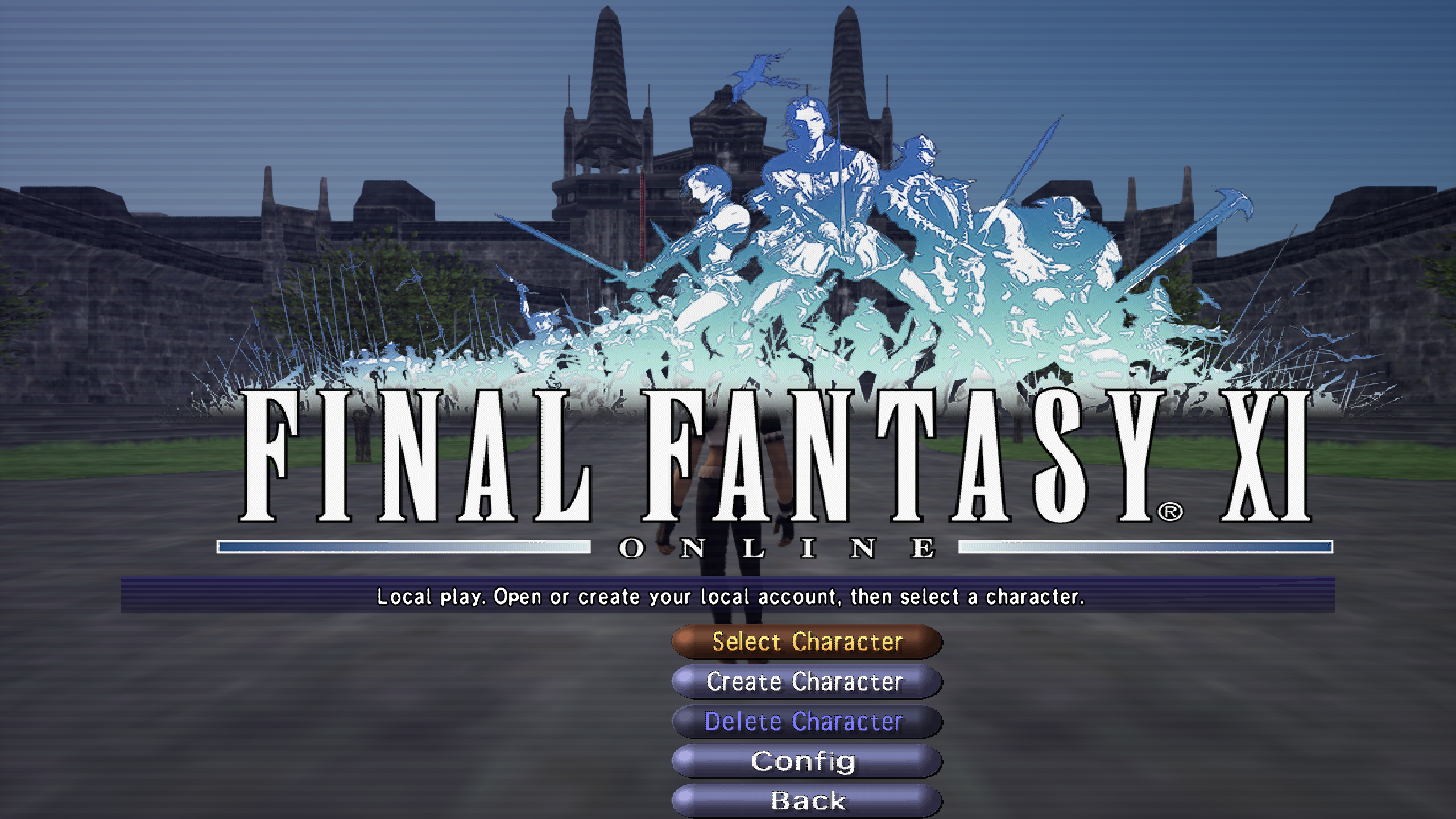
The title screen now uses the recognizable FFXI artwork, five lobby buttons and highlighted selection treatment over an in-engine scene. Keyboard and pointer selection are supported. Choosing a saved character leads to a confirmation before entering the world; this is a local account flow, not a connection to the retail service.
Character selection has moved into a dedicated window based on the original character-name list. It supports two columns of eight slots, highlights the current choice and turns the camera toward the character while the window is open. Character creation still uses a provisional screen; matching the full retail creation sequence is the next opening-screen pass.
The interface is also closer to the scale of my retail recording. The default size now follows the display height, with a saved Window Size setting for larger windows. The help line and chat log use the widescreen layout, long log lines wrap, and party names have more deliberate space. Existing retail fonts, status-icon help and saved log settings remain part of the foundation. I still need to playtest the whole interface for comfort, input behavior and readability.
Patch notes: recognizable monsters
The creatures in the currently admitted encounter roster now bind to their actual retail models instead of the placeholder spheres. Their presentation uses the source textures and skeletons, selects idle, walk or run motion as they move, and fades the visible model when appropriate. A packaged enemy scenario confirmed exact model bindings without falling back to the placeholder.
Alongside that playable subset, the reusable library has grown in batches. The latest 64-model addition was imported, reopened in a separate process and inspected on comparison boards. The total is now 112 imported models from a catalogue of 1,176 plain model identities. Of those imports, 108 have textured skeletal bodies; four elementals still need the particle-based parts of their appearance. Separately, 174 raw exports have been verified, leaving 1,002 in that export queue. Humanoid assemblies and special appearances have their own work still to do. These figures measure content preparation, not how much of the game is finished.
Patch notes: maps and connections
La Theine Plateau, Ghelsba Outpost, Valkurm Dunes and Konschtat Highlands have gained standalone source layouts with original terrain, materials and source-positioned markers. This brings the standalone layout count to ten. Jugner Forest and Batallia Downs have been prepared for a following import batch.
The markers help preserve where source content belongs, but they are not populated encounters or finished NPCs. Each area still needs collision and arrival checks, content placement, travel integration and a packaged playthrough. The zone catalogue contains 300 records, including special and transport entries; it does not represent 300 completed or even uniformly importable maps.
For connections, the goal is still to grow a coherent world. Completed continuous joins stay in place. Safe interim retail-style zoning is allowed where a physical connection is unfinished, with those transfers replaced one connection at a time. An arrival underground or on unsupported terrain is a defect to fix, not an acceptable zoning behavior.
Patch notes: characters, combat and persistence
Appearance and save handling now preserve face and size choices, and the work to resolve the correct race presentation is integrated. That does not mean every race is playable: the admitted live presentation remains Elvaan male at this checkpoint, and stored size still uses the medium visual presentation. The other bodies, equipment combinations and movement sets continue through their own checks.
Spell casting received an important packaged-build correction. The required cast-motion clips are now included in the game package, and cast actions stop cleanly when the session or action ends. Warrior ability values, player nuke and cure formulas, and Fast Cast recast handling have been updated within the current mixed-rules direction. Bard songs, Soul Voice and four usable instruments are also integrated; party-wide song behavior and the rest of the starting job kits remain unfinished.
Packaged checks continue to exercise local entry, saving, reopening and self- and enemy-targeted magic. A loot-related save check was corrected to account for a new character write after a defeated monster dropped an item. This makes the check reflect the actual session rather than assuming nothing changed after entry.
Patch notes: atmosphere and sound
The integrated weather simulation now derives regional conditions from the game clock, world seed, retail tables and neighbouring fronts. Weather-dependent spawns, elemental combat modifiers, morning fog conditions and storms affecting scent tracking are part of that underlying work. Some climate behavior is an intentional extension beyond retail Ronfaure.
Visible clouds, fog, rain and snow are still a separate presentation pass under development. I am not calling the full visual weather, moving daylight or seasonal system finished. Likewise, the local music and menu sound assets have passed loading checks, but listening, cue timing and volume still need an actual playtest.
What it means for players
The most meaningful improvement is that the game is beginning to look more familiar from the moment it opens. A recognizable title, a character list and properly displayed creatures make it easier to judge the experience as a game rather than as separate development pieces.
The larger asset library also gives future encounter and region work a consistent starting point. Reusing original models, textures and natural motion helps preserve the identity of each creature. Importing in bounded batches makes it possible to find missing effects, bad material bindings or animation mismatches before those problems are repeated throughout the world.
What the screenshots show
The title image above is a real capture from the 4 October packaged development check. It shows the retail artwork and button treatment in the local opening screen. The character is still visible behind the title, and that presentation remains unfinished. It is not a picture of a completed character-creation flow.
The gallery adds three more views from this checkpoint: an isolated monster comparison board, a sandy passage in Valkurm and Ghelsba’s bridge and outpost structures. The creature sizes on the board are normalized for inspection. The world images show imported source layouts, including unfinished boundaries; they do not prove that those routes are safe or available in normal play. All four captures are unedited.
What still needs work
There are two very different milestones here: having an asset in Unreal, and having it work correctly in a saved game session. I want to keep those distinctions visible as the content grows.
- Monsters: finish missing elemental effects, environment-responsive shading, source size variants, action animations and terrain-contact checks. The larger library has not expanded the live encounter roster yet.
- World: validate safe arrival, both directions of travel, collision, water edges, NPCs and population for each new area. The Ronfaure river candidate still needs the gameplay and appearance checks described in the earlier investigation.
- Opening and interface: finish retail-style character creation and remaining HUD details, then the services behind Map, Missions, Quests, Key Items and Macros. A menu entry alone does not establish a working feature.
- Characters and jobs: admit the remaining playable bodies and appearances, check equipment and motion in the game, and complete more of the starting job kits. This is not yet complete race or job coverage.
- Atmosphere and audio: complete visible weather and shelter behavior, validate lighting and water upgrades, and listen to the actual mix. Seasonal leaves, sleet and broader scenery improvements remain future work.
The latest integrated build completed its automated checks with 647 successful non-rendered tests and 659 successful rendered tests, plus two warning results in each run and no failed or unrun tests. Those warnings retain a refused spawn with missing floor support and an animation dependency. They remain visible issues. Separate packaged scenarios have passed, but these checks do not establish that every new library asset or map has been qualified in the packaged game.
I still need to playtest the full experience and judge how the controls, movement, camera, UI and combat feel together. None of the automated results are a substitute for that.
What’s next
The immediate priority is a dependable local session: start the game, choose a character, enter the world, travel safely, fight a recognizable monster, receive rewards, save and return to the same progress. Each improvement should make that sequence easier to test and more enjoyable to play.
In parallel, the next content batches will continue the monster library and prepared zone layouts. The work moves from import and visual inspection into collision, population and travel only when those dependencies are ready. I would rather show a clear boundary around a working area than label every imported map playable.
The longer-term tester target remains a private, player-hosted co-op prototype for two to four people. Session flow, shared combat, synchronized state and recovery need their own implementation and checks before invitations. There is no announced date or public signup.
For the website, I will keep related changes together in milestone posts like this one, with grouped patch notes, dated screenshots, known issues and a short next-step list. Small follow-up fixes can stay with their relevant update; a separate post should mark a meaningful new development stage. The older entries remain available as dated records of how the project reached this point.